

Secure software development depth
We have delivered security-focused applications used in mission-critical contexts over long product lifecycles.

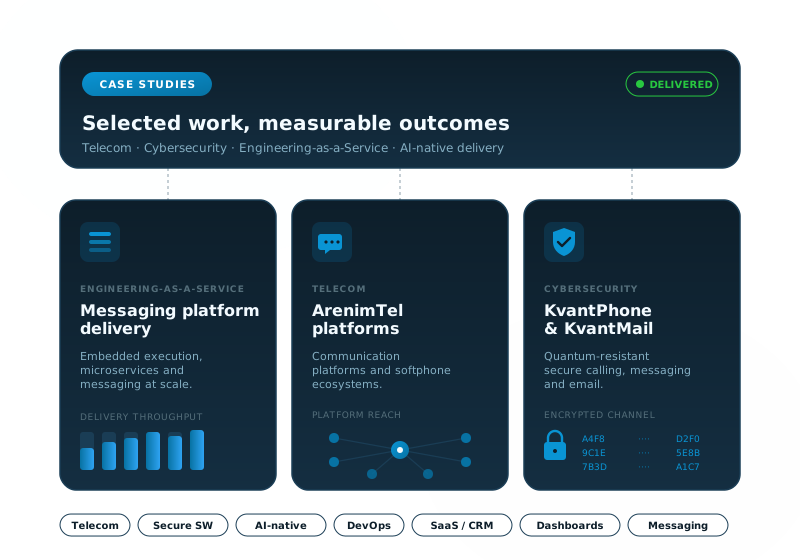
Selected examples of how Arenim applies secure engineering, telecom expertise, and AI-assisted delivery to real business and product challenges.
We have delivered security-focused applications used in mission-critical contexts over long product lifecycles.
We use AI across the engineering lifecycle to improve speed, throughput, and delivery efficiency.
We have built and operated communications products and platforms in demanding multi-platform environments.

Working with Arenim has been a true pleasure; their professional, collaborative team quickly understood our needs, delivered an excellent final product on time, and made the entire partnership smooth and rewarding.

Voice, messaging, and secure communication capabilities behind Arenim products.
Operational visibility, reporting, and business-critical oversight interfaces.
Integration work between business applications, communications flows, and operational data.
Support for product workflows and communications infrastructure.
Detailed examples of recent delivery work across telecom, secure communications, cloud platforms, and AI-assisted engineering. Open any case study to read the full narrative.
Engineering-as-a-Service · SaaS / B2B platform
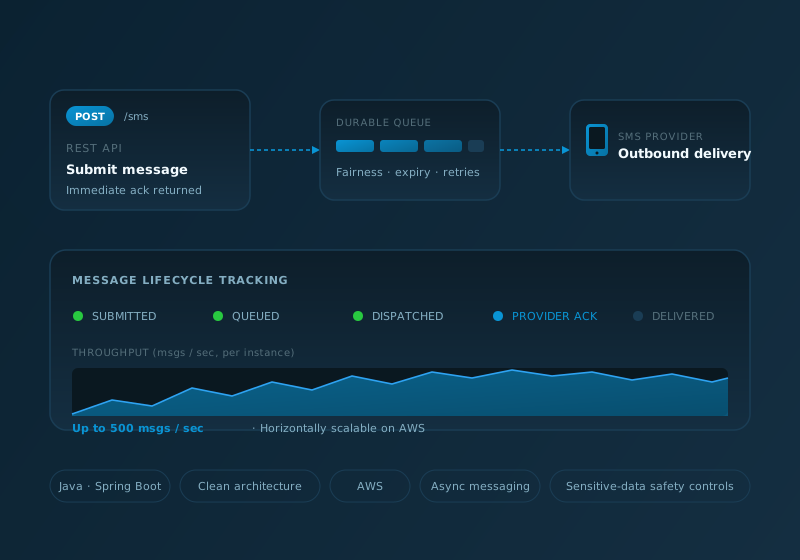
A leading event ticketing and booking company needed a reliable way to send large volumes of text messages to customers across its platform. Instead of requiring each internal system to manage message delivery on its own, we designed and built a centralized asynchronous message delivery platform.
The platform allows internal applications to submit message requests through a simple REST API and receive an immediate confirmation. Behind the scenes, each message is placed into a durable queue, processed asynchronously, and delivered through an external message provider. This approach separates the customer-facing systems from the complexity of message delivery, improving reliability, scalability, and operational control.
The system includes automatic retry logic for temporary failures such as network timeouts, provider issues, or service interruptions. Every message is tracked throughout its full lifecycle, from initial submission to delivery attempts and final confirmation.
The platform was designed for high-volume operation, supporting up to 500 messages per second per service instance, with horizontal scalability on AWS. It also includes important safeguards such as message expiration, queue fairness to prevent one internal caller from blocking others, and strict security controls to ensure that sensitive data such as phone numbers and message content never appears in application logs.
Built as a Java Spring Boot service using Clean Architecture principles, the platform became the reliable central backbone for text message communication across the company’s booking and ticketing ecosystem.
AI-native engineering · Healthcare
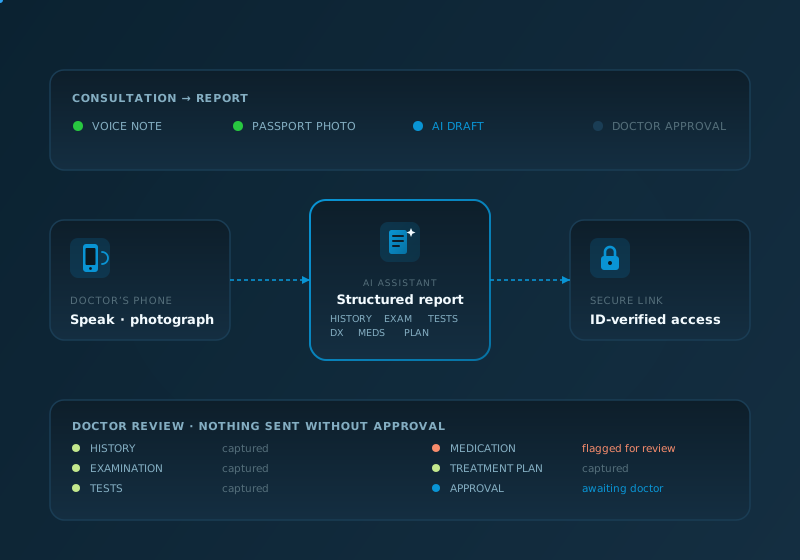
A travel medicine practice caring for travellers abroad — river cruise guests and crew, hotel guests, and patients seen on the road — needed to complete the documentation of a visit while still with the patient. Instead of reports being written up hours later, we designed and built an AI assistant that turns a spoken consultation into a finished medical report.
The doctor speaks into the messaging application already on their phone, describing the case in ordinary language, and photographs the patient’s passport. The assistant reads the document, organises what it heard into the practice’s own report structure — history, examination, tests, diagnoses, medication, and treatment plan — and returns a draft within moments. The doctor can then add findings, correct details, or move between several unfinished cases, without commands and without typing.
The assistant asks a short question when something genuinely matters, such as an unclear medicine or an unusable document photograph, while the patient is still in the room. Anything else left uncertain is highlighted for review rather than guessed at: the assistant documents, it does not practise medicine, and it never fills a gap with a plausible finding.
Nothing leaves the system without the doctor’s definitive approval, and approval applies only to the exact version reviewed. The approved report is issued in the practice’s own document layout and delivered to the patient through a secure link that opens only with the number of the identity document presented at the visit. Each medical business can configure its own report wording, and doctors follow their cases in a mobile-friendly secure web application.
The business result is substantial. Doctors save a significant part of the working time previously lost to administration, patients receive their medical report over an encrypted, secure channel immediately after the examination rather than days later, and the practice offers a noticeably better patient experience as a result. Every case is documented consistently and retained as a fully traceable, audited record — exactly the kind of documentation insurers expect.
Telecom · Multi-platform product engineering
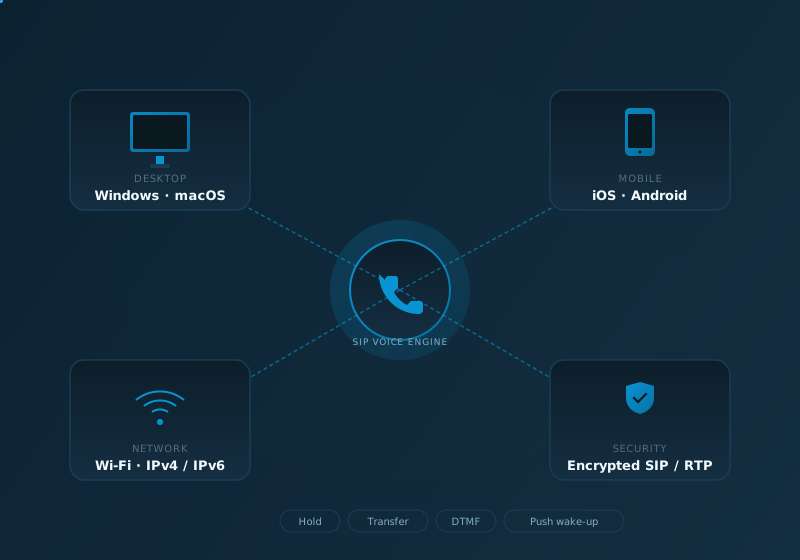
A leading cloud contact center software provider needed a reliable softphone solution that would allow users to handle business calls across multiple devices, including Windows desktop, macOS, Android, and iOS.
We designed and built a multi-platform SIP softphone service based on a proven voice engine, enabling users to make and receive calls through the provider’s cloud communication platform without relying on traditional desk phones. The solution gave agents and business users greater flexibility by allowing them to stay reachable from desktop computers, laptops, smartphones, and tablets.
The service supports the core calling features expected from a professional business phone system, including incoming and outgoing calls, call rejection, call transfer, mute, hold, speaker mode, headset support, DTMF tones, call history, and configurable ringing behavior. The user interface was designed to be simple and intuitive, so users could start handling calls without extensive training.
Special attention was given to real-world network conditions. The softphone was designed to operate across Wi-Fi, mobile networks, IPv4, IPv6, dual-stack environments, and NAT-based networks. On mobile platforms, the architecture also handles the limitations of background operation by using push notifications and a dedicated gateway layer to wake the application when an incoming call arrives.
Security and privacy were key design requirements. Signaling and media traffic can be protected using encrypted transport, while sensitive user data and configuration details are stored securely on the device. Diagnostic logging was designed to support troubleshooting without exposing confidential information.
The result was a reliable, scalable softphone foundation for a cloud contact center environment, extending professional voice communication beyond the office desk and enabling users to work effectively from virtually any supported device.
Cybersecurity · Cloud platform engineering
A cloud software provider needed a secure and highly available authentication service to support user login, machine-to-machine authentication, multi-factor authentication, and token-based access across its platform.
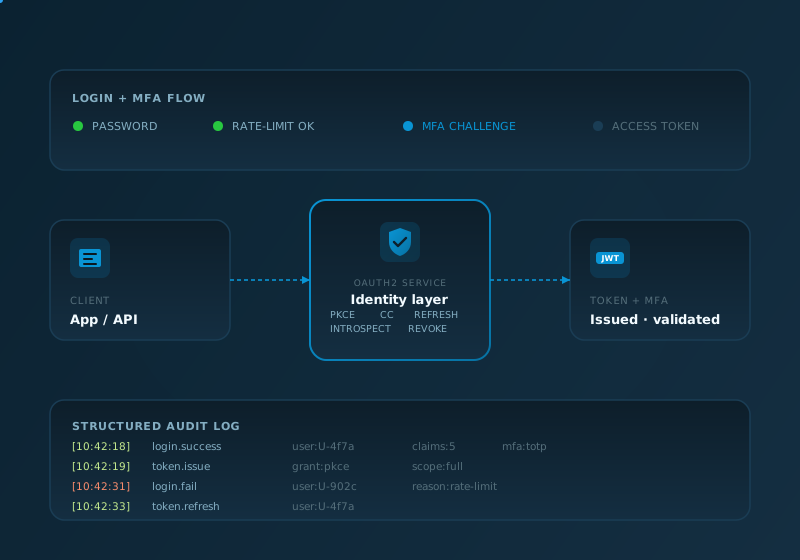
We designed and built a centralized OAuth2 authentication service that allows web applications, backend services, and API clients to authenticate through a single, reliable identity layer. The platform supports modern OAuth2 flows, including authorization code with PKCE for user-facing applications, client credentials for system-to-system communication, refresh tokens, token introspection, and token revocation.
The service provides a secure login experience with optional multi-factor authentication, password validation, rate-limit handling, and controlled password-change flows. It also supports extended session handling, allowing trusted users to remain signed in while still preserving strict token lifecycle control.
Security and traceability were key design requirements. The system includes structured audit logging for successful and failed login attempts, token issuance, refresh, introspection, and revocation events. Sensitive user and authorization data are handled through configurable token claims, with support for encrypted or compressed user detail payloads where required.
The architecture was designed for high availability and stateless operation. Authentication state is bound to OAuth2 request state, allowing login and MFA flows to continue reliably without depending on traditional server-side HTTP sessions. This makes the service easier to scale horizontally and more resilient in cloud environments.
The result was a robust authentication backbone for the software platform, providing secure user access, reliable API authentication, strong auditability, and flexible integration options for both frontend applications and backend services.
SaaS · Hospitality
A hospitality business operating apartments in Croatia needed a practical internal booking solution to manage properties, guest inquiries, reservations, availability, and booking documents in one place.
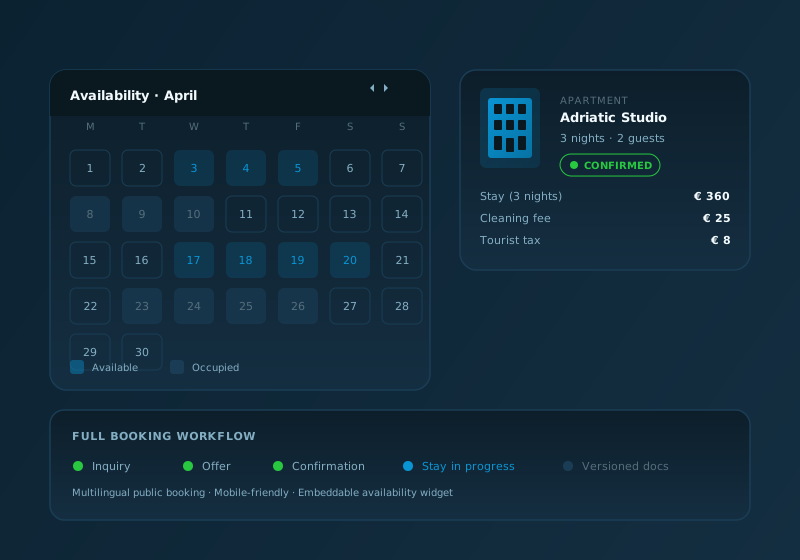
We designed and built a mobile-friendly, web-based booking platform that allows the business team to manage the full booking workflow from initial request to confirmed reservation. The system supports apartment management, guest records, booking requests, confirmed stays, pricing-related guest categories, cleaning fee logic, and tourist tax calculations based on configurable business rules.
The platform also generates professional booking documents, including offers and booking confirmations. These documents are created on demand, stored as versioned files, and remain linked to the relevant booking record, making it easier to track what was sent to the guest and when.
A key requirement was public availability visibility without exposing the full internal system. To support this, we built an embeddable availability calendar that can be placed on an external website. Visitors can see available and occupied dates in a clear, mobile-friendly calendar view. The embed can optionally include a booking inquiry form, allowing website visitors to submit requests directly from the public website.
The solution was designed for international guests, with multilingual support for the public-facing booking experience. The calendar and inquiry flow are optimized for both desktop and mobile visitors, showing a compact single-month view on phones and a wider multi-month view on larger screens.
Operational reliability was also part of the design. Separate development, staging, and production environments were introduced, allowing new features to be tested safely before release. The deployment flow supports fast iteration while protecting the live booking system from unfinished changes.
The result was a streamlined booking management platform tailored to the hospitality business, reducing manual administration, improving guest communication, and making real-time availability easier to present on the company’s public website.
Custom analytics · Decision support
An investment-focused client needed a more systematic way to evaluate complex stock option trading strategies that could not be identified reliably through manual market screening alone.
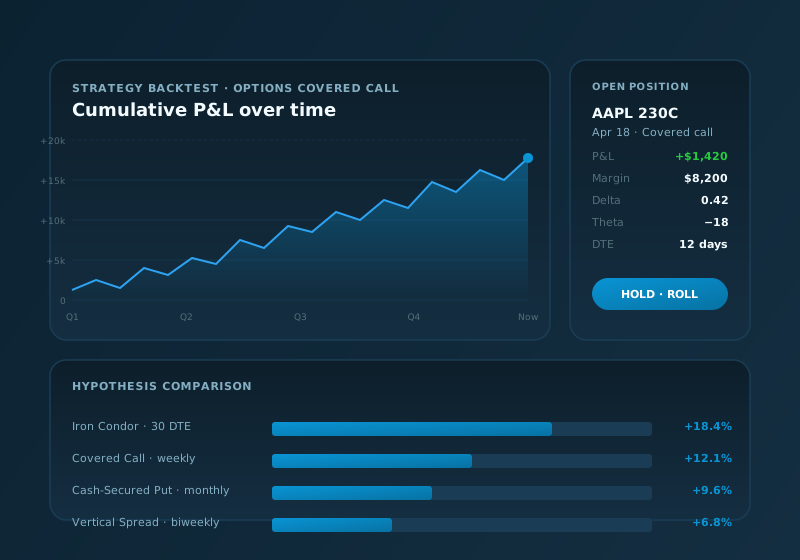
We designed and built a custom analytics and decision support platform that combined historical market data analysis, advanced search and filtering, trade simulation, time-series generation, and statistical evaluation in one workflow. The system allowed users to define trading hypotheses, test them against historical data, and compare potential option structures based on objective performance indicators.
The platform supported both historical backtesting and near real-time analysis using fresh market data. Simulated trades could be tracked over time, including position value, profit and loss, transaction costs, margin requirements, and portfolio-level performance.
A dedicated monitoring module helped users follow selected instruments and support decisions around opening, holding, adjusting, or closing positions. This made the platform useful not only for research, but also as an operational decision-support tool.
A key outcome was a proof-of-concept environment that transformed a complex trading idea into a structured, testable, data-driven software process. The solution created a strong foundation for future expansion toward live portfolio monitoring, operational reporting, and more advanced financial analytics.
Whether you need software delivery capacity or secure digital or secure communication products, we are ready to help.
Our team works closely with you to increase efficiency, reliability, and agility — so your business can move faster and operate with greater confidence.
Use the contact form and we will get back to you shortly.